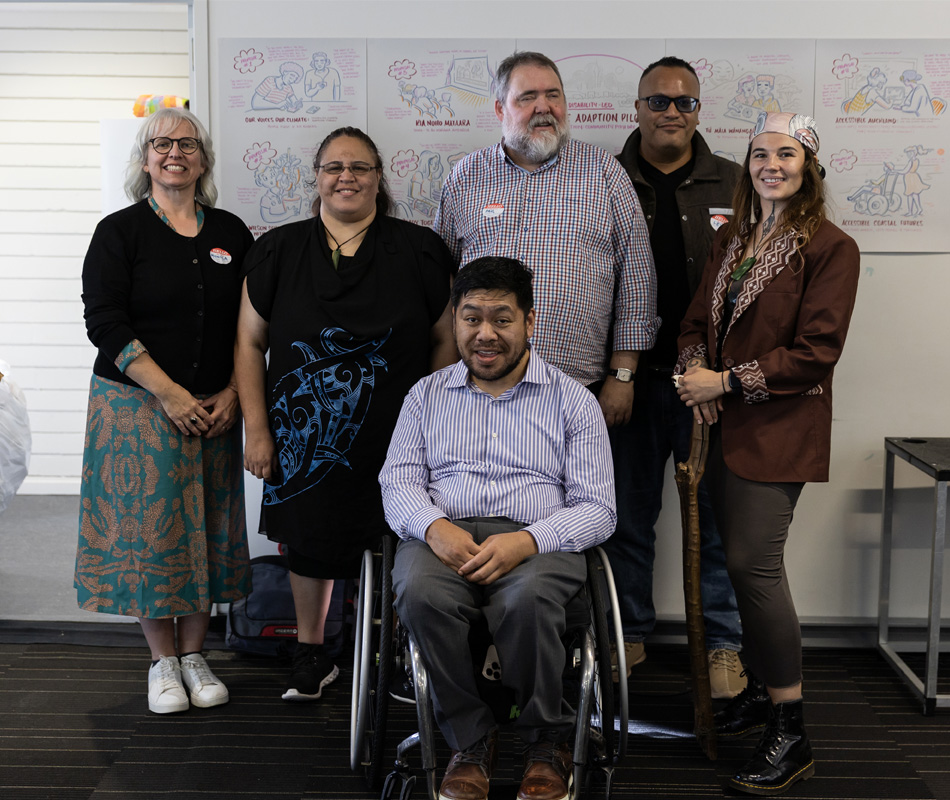
Grant Advisory Panel Members: Monica Leach, Tracey Gayner, Paul Brown, Leslie Marsh, Tamara Grant, Jade Farrar and Pip Patston (not in the photo).
For a long time, disabled people have been included in conversations about climate change because they are considered among those most affected by disasters and disruption.
This year, something different happened in Tāmaki Makaurau.
Instead of asking disabled communities what support they might need, Auckland Council, Foundation North, Spectrum Foundation and community partners created a process that asked a different question.
How can disabled people lead climate adaptation?
The Disability Led Climate Adaptation Pilot brought together disabled people, disability organisations, climate specialists and community leaders to design solutions that strengthen resilience, wellbeing and community capability. Rather than relying on traditional grant funding, the pilot used participatory grantmaking, placing funding decisions in the hands of disabled people themselves.
I had the privilege of serving on the disability led Grant Advisory Panel alongside Monica Leach, Paul Brown, Leslie Marsh, Tamara Grant, Jade Farrar, Pip Patston and others. Our role extended far beyond assessing funding applications. As a panel, we helped shape the grant process itself, developed assessment criteria, supported applicants as they refined their ideas and worked together to recommend the projects that would receive funding.
Being involved reinforced something many disabled people have known for years. Communities already have the knowledge and lived experience needed to develop practical solutions. Sometimes what has been missing is a process that trusts people to lead.
Over several months, participants explored how climate change affects disabled communities, attended workshops, received mentoring and developed projects designed around the realities of everyday life. Nine groups eventually presented their ideas during a public Pitch Day, demonstrating just how much innovation already exists within our communities.
In July, six disability led projects were awarded a share of $200,000 through the pilot.
The successful projects reflect the diversity of disability communities across Tāmaki Makaurau.
Auckland Deaf Society will deliver climate adaptation workshops entirely in New Zealand Sign Language, alongside a library of NZSL video resources that make preparedness information more accessible.
My Life My Voice is developing an accessible planning app that will help disabled people and their whānau create personalised emergency and resilience plans that can be shared with trusted support networks.
Te Ao Mārama Aotearoa, TAMA, will produce a series of educational films presented in te reo Māori, English and NZSL, combining mātauranga Māori, emergency preparedness and climate adaptation.
CCS Disability Action is building on decades of community gardening experience by delivering workshops that strengthen food security, sustainability and practical climate resilience.
Wilson School, working alongside Te Hōnonga a Iwi, will create food gardens, composting systems and native plant nurseries that connect students, educators, iwi and environmental restoration through hands on learning.
People First New Zealand and XR Rogers will deliver a disability led climate adaptation forum, alongside Easy Read resources, videos and personalised emergency planning tools for people with learning disabilities.
Each project approaches climate adaptation differently, yet they all share one common principle. The people most affected by the challenges are leading the solutions.
The pilot also challenged a long held assumption about disability and climate change.
Too often, disabled people are viewed only through the lens of vulnerability. While disabled communities do face disproportionate risks during emergencies and climate events, this project recognised something equally important. Disabled people bring creativity, lived expertise, innovation and leadership that strengthen resilience for everyone.
For me personally, the experience was also an opportunity to contribute to a different way of working. Throughout my career I have advocated for disability led decision making across funding, community development and systems change. Seeing those principles put into practice through this pilot demonstrated what becomes possible when power is genuinely shared with communities.
The projects will begin from August 2026 and continue over the next two years with implementation support from Spectrum Foundation.
While the funding itself is significant, the greatest achievement may be the process that made it possible.
This pilot showed that when disabled communities are trusted to lead, the outcomes extend well beyond individual projects. Communities build confidence, relationships grow stronger, leadership develops and solutions emerge that are practical, accessible and grounded in lived experience.
That is a model worth building on.
At Accessible Futures, we believe this is what community led development looks like. When people have the opportunity to shape decisions that affect their own lives, the result is stronger projects, stronger communities and better outcomes for everyone.
Sometimes the biggest innovation is not the project itself.
It is changing who gets to lead.
Learn more about the pilot and projects: https://bit.ly/44zlSZQ


Leave a Reply